
Injection molding is one of the most efficient ways to create molded rubber products in many applications, making rubber injection molding services a practical choice for high-volume production because it takes away a sizable portion of the labor content associated with other molding operations. It is most typically used in mass-production processes where the same part is being created thousands or even millions of times in succession.
Injection molding is the process of manufacturing parts by injecting material into a closed mold. It was based on a process that was initially developed for molding plastics in the 1960s, but rubber injection molding requires significantly more pressure than plastic per square inch of cavity surface (and plastics are cooled when molding while rubber is heated).
The Process
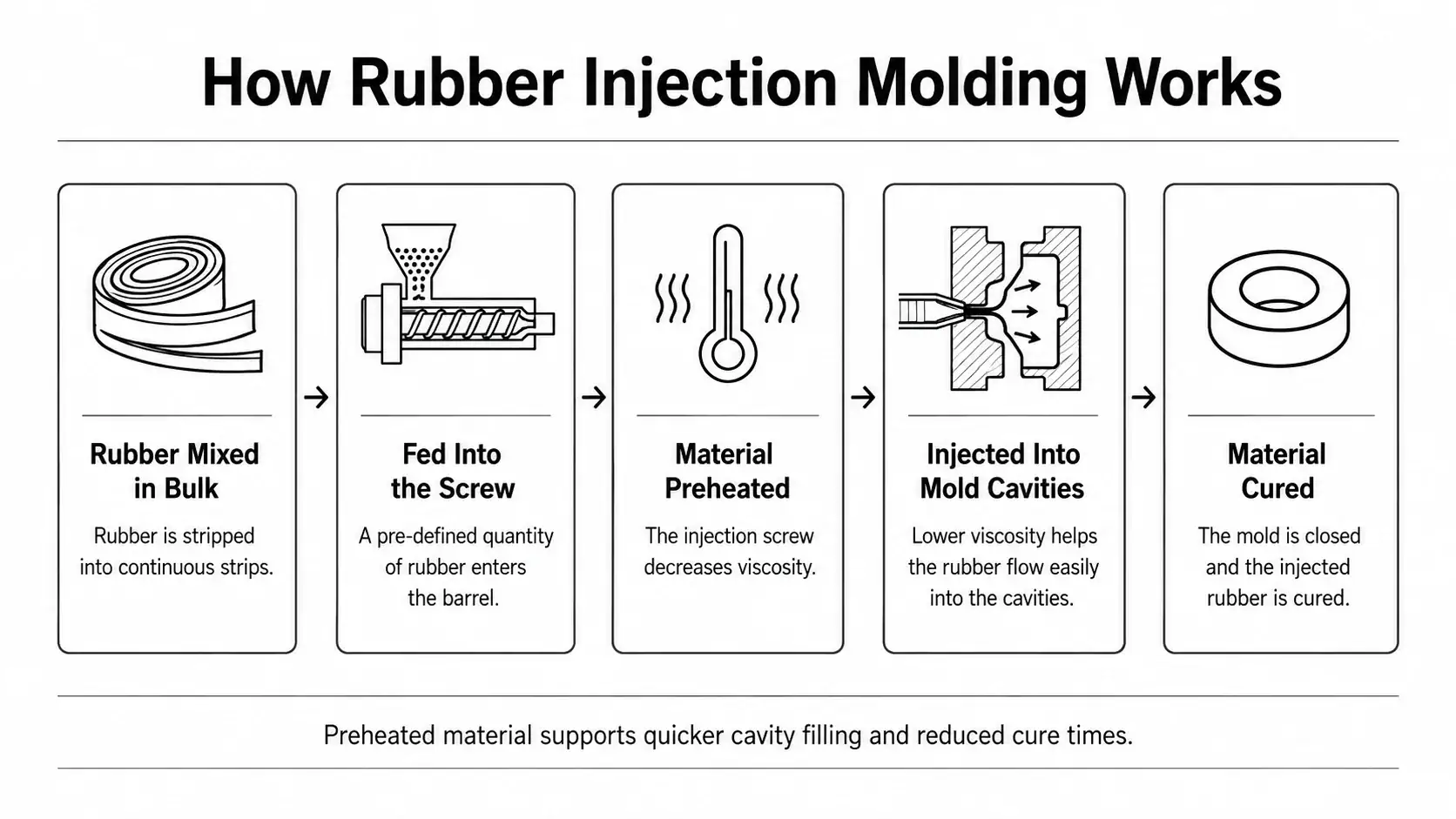
The rubber is mixed in bulk then stripped into continuous strips and fed into a screw which feeds into a barrel with a pre-defined quantity of rubber material. The injection screw then pre-heats the material before it is forced into the cavities (which works to decrease the viscosity of the material so that it is able to flow easily into the cavities). The mold is then closed, and the material in the barrel injected into the mold cavities and cured.
Organic rubber injection allows for the elimination of operator placement of pre-forms, and quicker cycle times compared to compression and transfer molding.
Using Rubber Injection Molding
Advantages
The ability to scale production to meet demand while reducing labor costs is a primary reason manufacturers choose injection molding. After the initial tooling and design costs are addressed, the piece price can become relatively low, with economies of scale increasing as production volumes grow.
Rubber injection molding services also offer repeatability and lower processing costs. Each part can be produced to closely match the previous one, helping maintain product performance, dimensions, and aesthetics across larger production runs.
The equipment handles the measuring and injection of the material into the tool. This reduces operator handling and helps control production costs. Unlike compression and transfer molding, injection molding does not require preforms to be manually positioned in a cavity or pot, eliminating another labor-intensive step that can affect finished-product uniformity.
Cure times can also be reduced because the injection screw delivers preheated material. Lower viscosity allows the rubber to fill cavities quickly, while the curing process has already been initiated through screw charging and shear during injection.
Injection molding can also produce lower scrap and waste rates. Material waste generally comes from the sprue, runners, gate locations, and overflow material that may escape the part cavity. These areas can be addressed through tool design and process control.
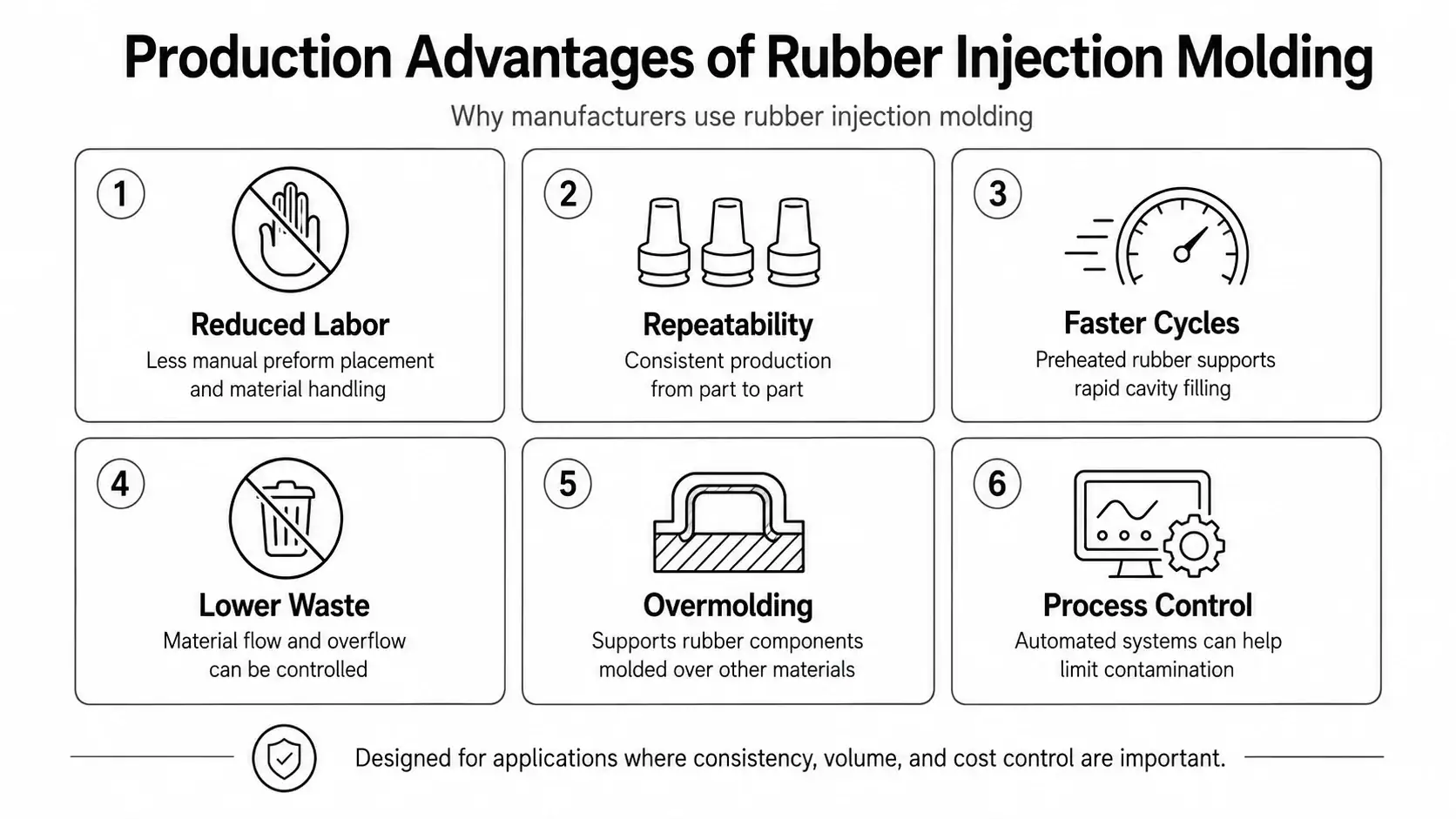
| Benefit | Production Advantage |
|---|---|
| Reduced labor | Less manual preform placement and material handling |
| Repeatability | Consistent production from part to part |
| Faster cycles | Preheated rubber supports rapid cavity filling |
| Lower waste | Material flow and overflow can be controlled |
| Overmolding | Supports rubber components molded over other materials |
| Process control | Automated systems can help limit contamination |
Other benefits include reduced cycle time, flashless tooling, the capability to produce overmolded products, automated closed-loop systems that limit contamination, optimized cycle times, and the production of parts that are nearly flash-free.
Disadvantages
Potential disadvantages of rubber injection molding are generally associated with incorrect settings, tooling conditions, contamination, or human error. Temperature, pressure, material measurements, injection speed, and clamping force all need to be properly controlled for consistent results.
Parts produced through the rubber injection molding process are generally produced with very little flash, but flash may still occur because of tool damage, excessive injection speed, or insufficient clamping force.
A short shot, sometimes called a non-fill, can occur when the mold does not receive enough material to completely fill the cavity. Adequate material volume, proper injection speed, and appropriate temperature settings can help prevent this issue. Voids or air pockets may also develop when injection pressure is insufficient.
Foreign matter can enter the process if the tool surface or barrel is not properly maintained. Warping, where parts become twisted or distorted, can occur when cooling time is too short or the material is too hot.
Proper process monitoring and equipment maintenance are therefore important considerations when selecting rubber injection molding services for production applications.
Applications
There are many applications for rubber injection molding across a wide range of industries. The process is particularly useful for producing repeatable rubber components in high-volume applications.
Common molded rubber products include:
- Grommets
- Seals
- Rubber caps
- Rubber plugs
- Vibration mounts
By combining controlled material delivery, automated injection, and repeatable curing, rubber injection molding services can support production requirements where consistency, volume, and cost control are important.
Ready to Make Every Part Count?
When consistency, production volume, and cost matter, the right molding process can make a measurable difference. Work with Jefferson Rubber to turn your rubber component requirements into a reliable production solution. Let’s build parts that perform again and again.