
Jefferson Rubber is a United States-based manufacturer of compression molding. Compression molding rubber is the earliest and simplest form of rubber molding, having a process similar to that of making a waffle. The technology for compression molding was initially developed for molding plastics and then adapted for rubber applications. It is the most widely used and well-established molding method and, in most cases, an efficient and economical production method for many rubber products.
The process is best suited to low production volumes of medium to large-sized parts that use higher-cost materials. Compression molding is viewed as being labor-intensive, but this can be addressed through automation to a point where it matches the efficiency of injection molding. As an established option for rubber molding services, compression molding can provide a practical solution for a variety of production requirements.
The most used materials for compression molding are polyurethane, polyethylene, SBR, and Neoprene. Other high-cost materials such as fluoroelastomers, fluorosilicone, and perfluoroelastomers are also used.
The Process
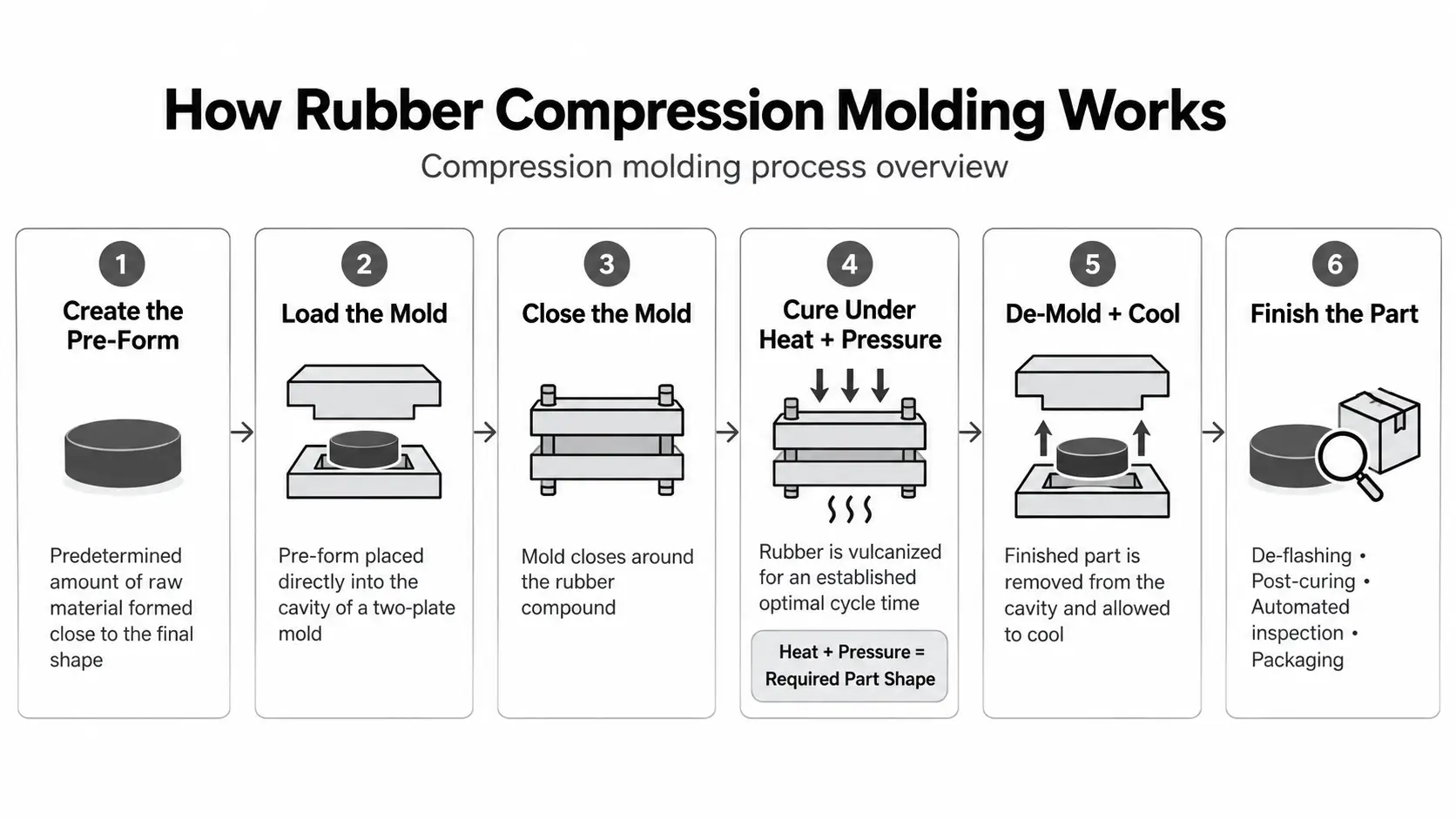
A predetermined amount of raw material or compound is formed into what is called a “pre-form” that is close to the shape of the end product. These shapes are then placed directly into the cavity of a mold consisting of two plates. After this, the mold is closed, and the rubber is then cured.
The curing process holds the rubber in the mold under high pressure and raised temperatures to activate (or vulcanize) the rubber for an established optimal cycle time. This combination of heat and pressure is a key part of compression molding rubber and helps form the material into the required shape.
Once the process has completed, the shapes are then demolded, where the parts are removed or ejected from the cavities, allowing for the next cycle to begin. The cured part is taken out of the mold, allowed to cool, and then undergoes its finishing process. This can include de-flashing, post-curing, automated inspection, and packaging.
Using Rubber Compression Molding
Advantages
The simplicity of the required tooling makes compression molding economical and allows for ease of prototyping and short lead times. The manufacturing process that utilizes heat and pressure to bond the rubber compound into the required form leaves minimal parting lines (seams).
In many instances, it is a cost-effective solution if either the compression molding tooling already exists, the quantity required is low to medium volume, or if extreme material hardness is needed. These advantages make compression molding a useful option within a range of rubber molding services.
Disadvantages
Rubber compression molding is limited as it is a more labor-intensive method compared to other molding options, making it ill-suited for higher-volume applications.
The process requires a pre-form (a pre-measured amount of material), and compression molding can provide poor consistency. In addition, it is difficult to control flashing (excess material attached to a mold, typically caused by leakage of the material between the two surfaces of a mold).
Applications
Rubber compression molding has applications for most industries, from aviation to aeronautics. As part of its rubber molding services, Jefferson Rubber can use compression molding for a wide variety of rubber components and applications.
Medium hardness materials (60A–90A materials) work the best in compression molding, but the process can easily manage materials with higher durometers. The high levels of cavity pressure are difficult to obtain with other molding processes without the degradation of the material’s properties, making compression molding the more popular choice.
Compression molding is an efficient process for products that do not require bonding to metal, such as gaskets, O-rings, brake diaphragms, bushings, golf balls, and shoe soles.
As rubber offers protection from electrical currents, there are many other applications for compression molding rubber, including the manufacture of electrical wall receptacles, circuit breakers, appliance housings, electric plugs, and sockets.
Rubber is also heat and slip-resistant, so compression molding works for many domestic applications such as pot handles, cookware knobs, brush and mirror handles, and cooking utensils.
Automobile parts and household appliances, as well as fasteners, use compression molding. Kitchenware such as bowls and cups is often manufactured with compression molding. Other uses include electrical housings, switches, and handles.
Compression Molding vs. Standard Injection Molding
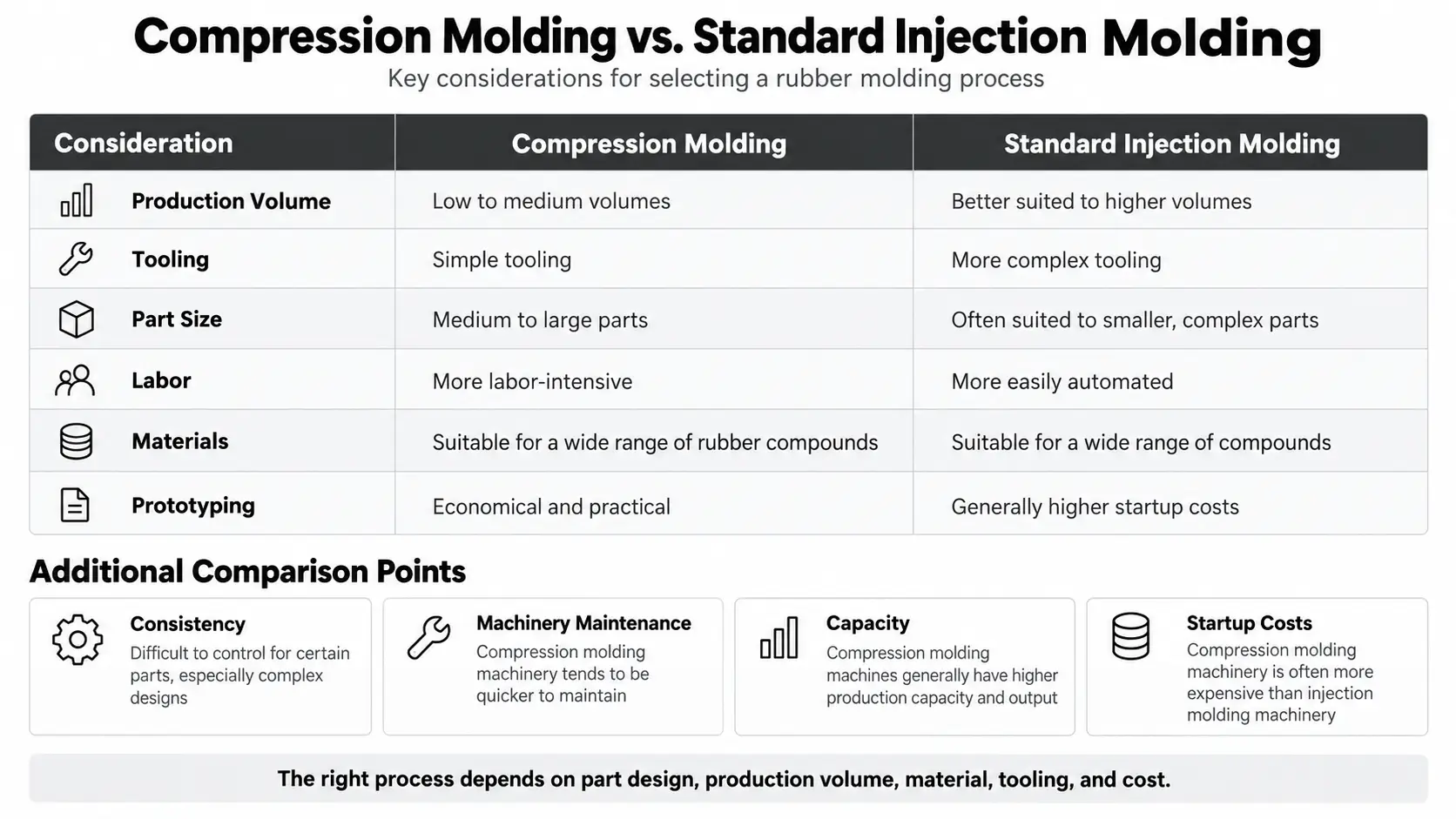
Consistency: Consistency is the largest issue with compression molding. Since it is difficult to control compression molding, it may not be the best choice for certain parts, especially those with a complex design.
Machinery maintenance: Maintaining compression molding machinery tends to be quicker than injection molding.
Capacity: Compression molding machines generally have higher production capacity and also provide a higher output than injection molding.
Startup costs: It is often more expensive. Compression molding machinery is often more expensive than injection molding machinery. These costs must be passed on to the end user.
| Consideration | Compression Molding | Standard Injection Molding |
| Production Volume | Low to medium volumes | Better suited to higher volumes |
| Tooling | Simple tooling | More complex tooling |
| Part Size | Medium to large parts | Often suited to smaller, complex parts |
| Labor | More labor-intensive | More easily automated |
| Materials | Suitable for a wide range of rubber compounds | Suitable for a wide range of compounds |
| Prototyping | Economical and practical | Generally, higher startup costs |
Choosing between compression molding and injection molding depends on factors such as part design, production volume, material, tooling, and cost. Jefferson Rubber can help determine whether compression molding rubber is the right solution for your application.
Work With Us
Looking for dependable rubber molding services for your next project? Jefferson Rubber provides compression molding solutions for a wide range of rubber products and applications. Contact Jefferson Rubber today to discuss your molding requirements and get started.