
Jefferson Rubber is a USA-based leading compression molding manufacturer. Silicone injection molding, also known as LIM, has been used since the late 1970’s and has a wide range of applications across a number of different industries, including medical, automotive, appliances, electronics, and aerospace. It is similar to rubber injection molding, where the silicone rubber material is forced through an injection nozzle and is injected into the mold cavity and cured under heat and pressure.
Our Liquid Injection Molding capabilities include Liquid Silicone Rubber (LSR) process technologies for both clear and colored silicone parts. Our LSR molding capabilities provide manufacturers with an efficient option for producing consistent silicone components for a variety of applications.
Liquid Silicone Rubber (LSR) is a proprietary name for a range of two-component Liquid Silicone Rubbers used to produce elastomer parts by injection molding. Because of its high thermal stability, good rubber-like properties, and resistance to aging, LSR is the material of choice for many industries, including medical, military, electronics, appliance, automotive, and textile industries. The material has a wide temperature range (-94-degree F to +400-degree F) with low compression set and resistance to the damaging effects of sunlight and ozone.
The process for molding Liquid Silicone Rubber (LSR) is suitable for relatively small parts with high annual volume needs. This material allows for very short cycle times, which makes it an ideal candidate for two-shot molding with plastic material. Silicone injection molding is particularly suited to applications requiring repeatable, high-volume production of small and precise components.
Silicone rubber is an elastomer (a rubber-like material) that is biocompatible, stable, inert, and flexible, as well as heat-resistant and often used in the medical product industry.
Liquid Silicone Rubber Properties
| Property | Benefit |
| High thermal stability | Supports performance in demanding temperature conditions |
| Wide temperature range | Suitable for applications from approximately -94°F to +400°F |
| Low compression set | Helps components maintain their shape after compression |
| Sunlight and ozone resistance | Helps protect parts from environmental exposure |
| Flexibility | Provides rubber-like performance for many applications |
| Biocompatibility | Makes certain silicone materials suitable for medical applications |
| Multiple Durometers | Allows material characteristics to be matched to application requirements |
| Clear and colored options | Supports different products and design requirements |
The Process
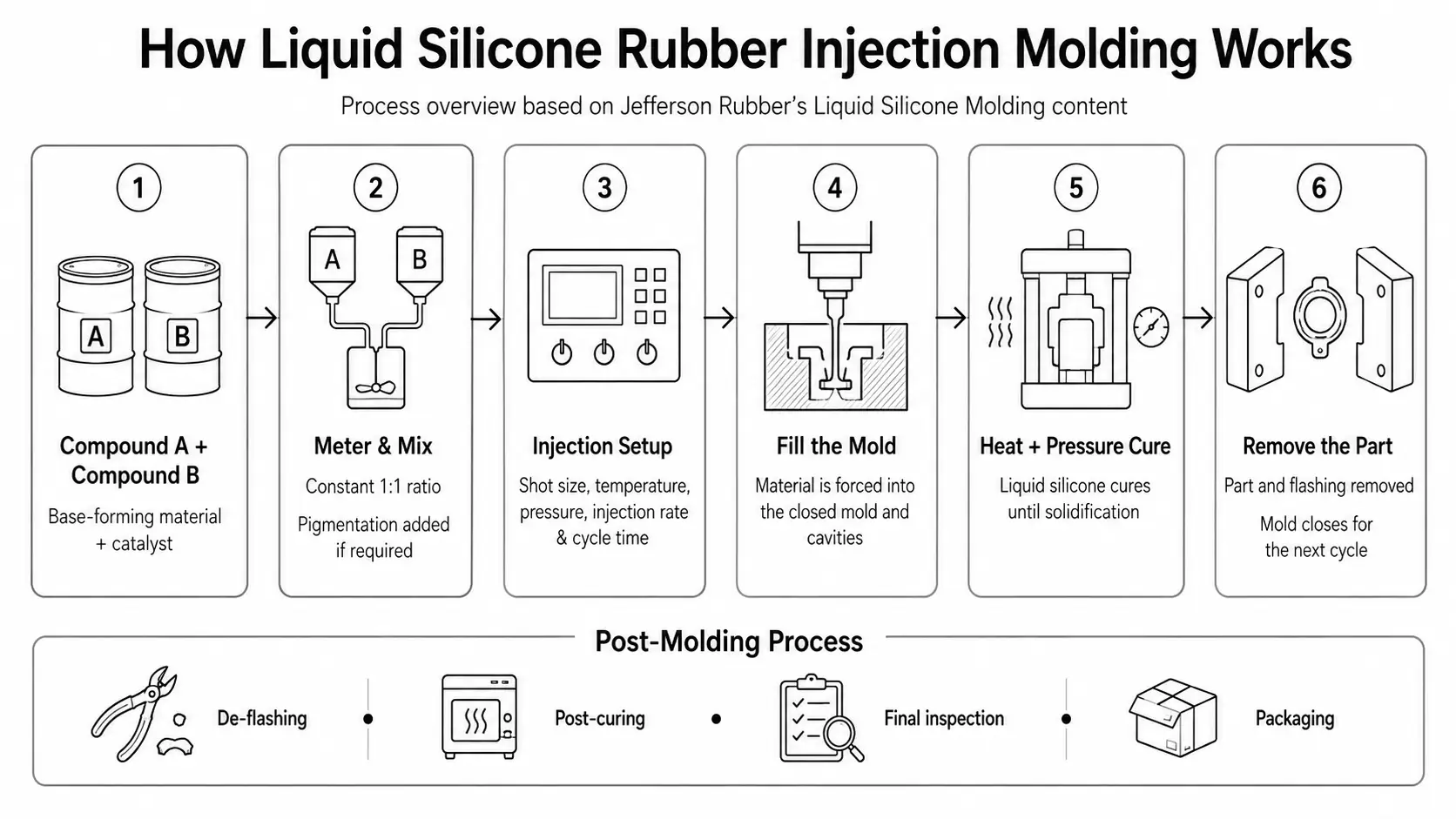
The process uses a two-part silicone compound (made up of A and B parts in separate containers) that is connected to the pumping system and delivered at a set ratio to a static mixer. Compound A will typically be the base-forming material, and Compound B will be a catalyst. The mixture is blended by a platinum cure system, then moved into the injection unit. From there, it is injected into the closed mold through a runner and gate system. Once the product is cured, the parts are either removed or ejected from the mold cavities, and the mold is then reused for the next cycle.
The products may then move through the post-molding process. This could include de-flashing if needed, post-curing, inspection, and packaging.
Using Liquid Silicone Injection Molding
Advantages
Using Liquid Injection Molding of liquid silicone rubber offers a number of benefits, including an efficient production process and applications for the medical product industry.
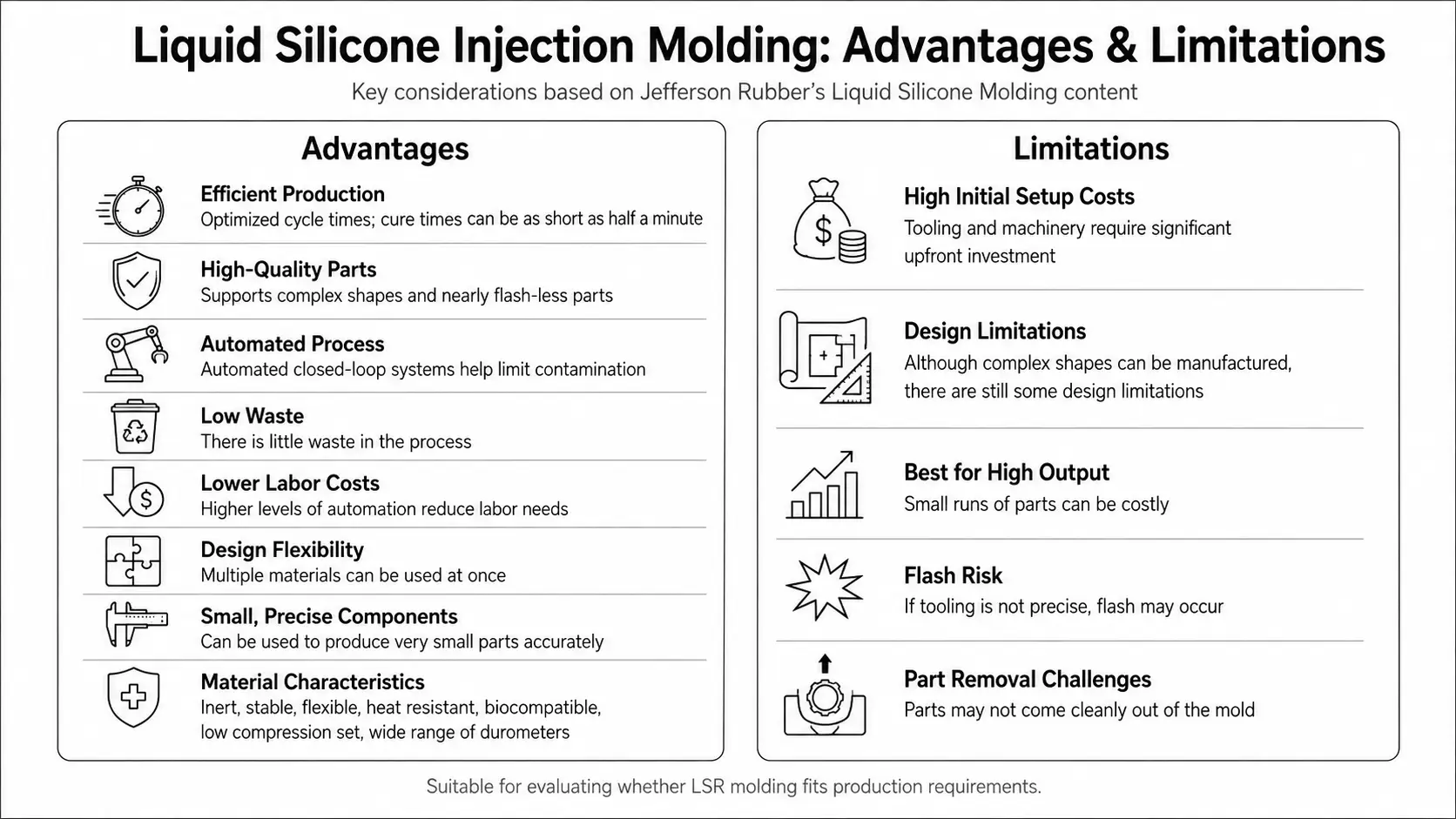
The LIM process cost-effectively produces high-quality parts. The process can be used for complex shapes, producing nearly flashless parts, and the automated closed-loop systems work to limit contamination. Optimized cycle times (quicker than compression and transfer molding) ensure that cure times can be as short as half a minute, and there is little waste in the process.
Low labor costs due to higher levels of automation, design flexibility, and the ability to use multiple materials at once mean that LIM has a wide range of applications. The process can be used to produce very small parts accurately.
LIM materials are inert and stable, flexible, heat-resistant, and biocompatible. They also have a low compression set with a wide range of Durometers. This makes them well-suited to the needs of the medical industry. These characteristics also make LSR molding a practical option for manufacturers requiring consistent silicone components.
Disadvantages
The limitations of liquid injection molding include the high initial setup costs of tooling and machinery, and although complex shapes can be manufactured, there are some design limitations. The process is designed for high output levels, so small runs of parts can be costly.
Liquid silicone has a low viscosity, and if the tooling is not precise, then flash may occur, and the parts do not come cleanly out of the mold.
Liquid Silicone Rubber Part Production
The liquid silicone rubber injection molding manufacturing process molds silicone rubber into various parts and products. Unlike reaction injection molding (RIM), LSR utilizes a pressurized impingement mixing process, mechanically mixing a two-component compound in a mold.
The main differentiation between liquid silicone molding and plastic injection molding relates to the delivery of the material. The tool is loaded into an advanced LSR-specific injection-molding press designed for precision control of the shot size, enabling the consistent fabrication of liquid silicone rubber components.
The main steps in the liquid silicone rubber injection molding process are:
- The uncured liquid silicone starts in two containers consisting of Compound A and Compound B, which connect to the pumping system. Barrel A holds the base-forming material, and Barrel B contains a catalyst. A metering unit automatically releases the two substances at a constant one-to-one ratio, also adding any required pigmentation additive.
- The molding machine operator will program the automated injection-molding machine, allowing the injection setting to deliver the appropriate shot. The platens and pistons, which align and close the mold, have settings for temperature, pressure, injection rate, and cycle time, adjusted in compliance with the end users’ specifications.
- After setup, the molding machine heats the mold to the appropriate temperature and applies the correct clamping force. The mold closes in coordination with the machine’s injector, pump, and supply, allowing the mechanism to force the material into the mold and cavities.
- A combination of heat and pressure applied to the liquid silicone rubber cures the material until solidification. After cycling, the mold opens, and the part and flashing are removed automatically or manually. The mold then closes, and the process is repeated.
- Upon removing the item from the mold, the post-molding process may include de-flashing, post-curing, final inspection, and packaging.
Manufacturing LSR components often requires creatively solving problems that will often arise. Experienced silicone injection molding manufacturers can help address these challenges during the production process, since it is critical to the production process and will save customers time and money.
Applications
Liquid silicone rubber parts may also be biocompatible and fit very well for products that have contact with the skin. Products meet strict FDA requirements due to their physical properties and resistance to chemicals and heat. This is used in medical and healthcare for products such as flow control valves, syringe stoppers, and other components.
In the automotive industry, it is used for products such as O-rings and gaskets, valves, and cables because LSR products can also be directly molded onto plastic or metal.
Consumer product applications include showerheads, bakeware, appliances, and electronics.
Liquid Silicone Injection Molding Applications
| Industry | Example Applications | LSR Characteristics |
| Medical & Healthcare | Flow control valves, syringe stoppers, and medical components | Biocompatibility, flexibility, heat, and chemical resistance |
| Automotive | O-rings, gaskets, valves, cables | Flexibility, durability, and environmental resistance |
| Appliances | Appliance components | Heat resistance and flexibility |
| Electronics | Electronic components | Stability and environmental resistance |
| Aerospace | Silicone components | Temperature and environmental resistance |
| Military | Silicone components | Stability and durability |
| Consumer Products | Showerheads, bakeware, appliances | Flexibility and heat resistance |
Jefferson Rubber offers quality Liquid injection molding production from design assistance and manufacture of your design to final finishing and assembly. We specialize in LIM and have the capability to provide an end-to-end solution from parts design assistance, prototyping, production, finishing, and assembly. This means that you do not have to work with multiple companies – JRW is your one-stop resource for all your silicone injection molding requirements.
Work With Jefferson Rubber
Need help determining whether LSR molding is right for your application? Jefferson Rubber can help with your liquid silicone injection molding requirements, from design assistance and prototyping through production, finishing, and assembly. Contact Jefferson Rubber today to discuss your silicone injection molding project and learn how our capabilities can support your production needs.